
Fast simulations
A production-scale group model runs in about 15 minutes on a laptop and under 3 minutes on a tuned server. Runtime depends on the model and hardware.
A full capital model with detailed underwriting risk and reinsurance is difficult and expensive to build. Many insurers rely on broker models for analysis they cannot easily extend or rerun themselves.
Aktua brings a fast simulation engine, an accessible interface and AI assistance to the work of building and using these models.
Aktua was created by David, an economic capital modeling (ECM) expert with six years of experience building models in ReMetrica and Igloo for about a dozen insurers.
Long runtimes and difficulty tracing calculation logic motivated him to build an engine that made models easier to check, run and maintain. That experience shaped Aktua's emphasis on simulation speed, reproducible results and accessible modeling tools.
Underwriting, catastrophe, reserve and asset risk, with detailed reinsurance structures. A powerful, flexible correlation engine brings these risks together at portfolio level. Aktua is a desktop application, currently in private alpha.
A production-scale group model runs in about 15 minutes on a laptop and under 3 minutes on a tuned server. Runtime depends on the model and hardware.
Model quota share through aggregate catastrophe excess of loss, including reinstatements and inuring order. Compare the effect on retained losses and capital.
Repeat a run with the same inputs and seed to reproduce its results. Inspect assumptions and compare scenarios as the model develops.
Ask questions and request model changes in plain language. Review the proposed changes and keep control of the assumptions. The engine performs the calculations.
Configure dependence within and across risk units and between underwriting and reserves. Choose Pearson or Spearman targets, or direct copula parameters, with Gaussian and Student-t copulas.
Inspect realized correlations and joint tail behavior, then compare the results with your assumptions. Matrix validation helps identify inputs that need attention.
Premium, losses, expenses and profit before and after reinsurance, with volatility and 1-in-200 outcomes side by side.
View full-size screenshot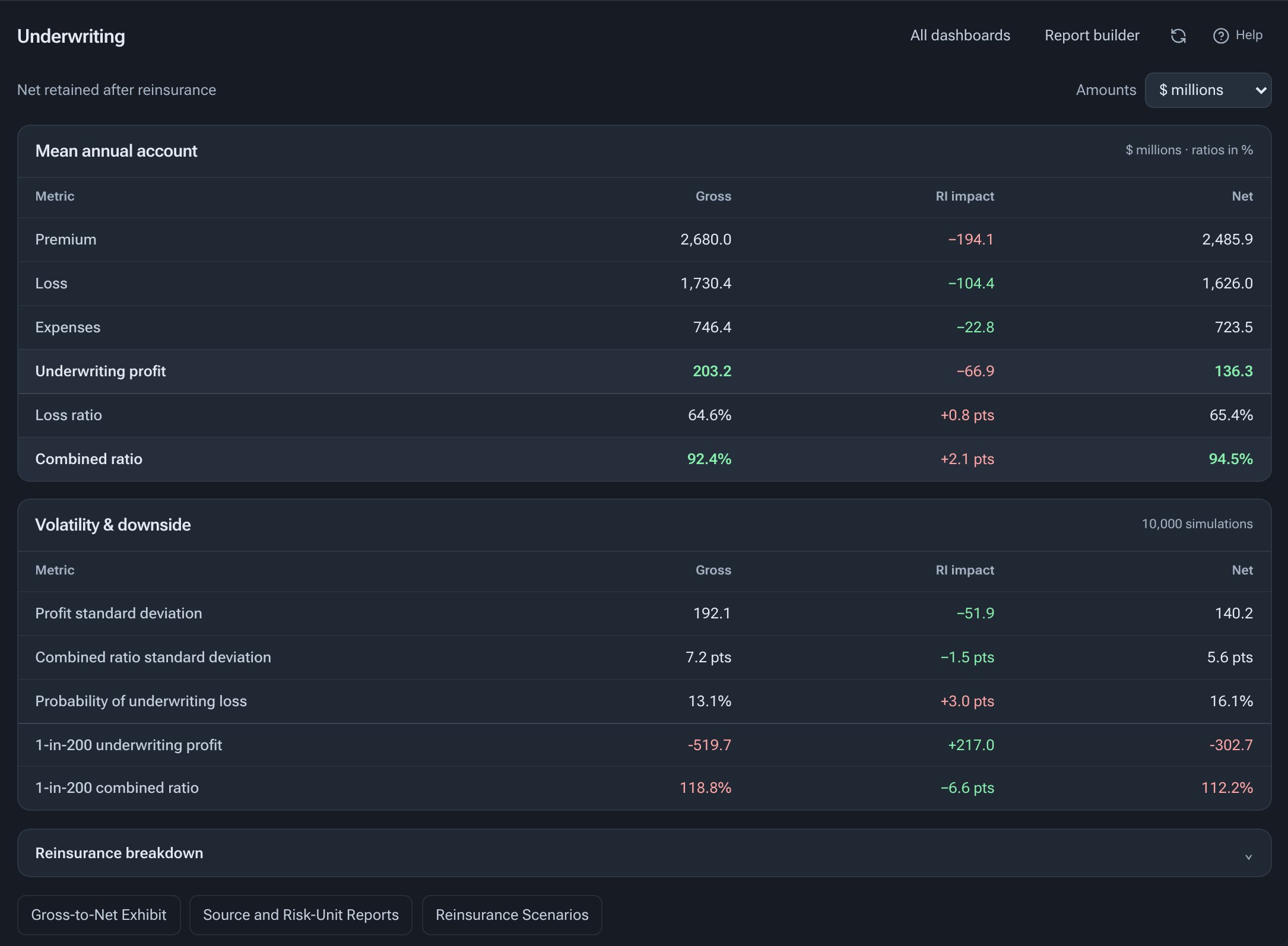
Attach and exhaust probabilities, the recovery curve by return period, terms and utilization, and which risk units drive the recoveries.
View full-size screenshot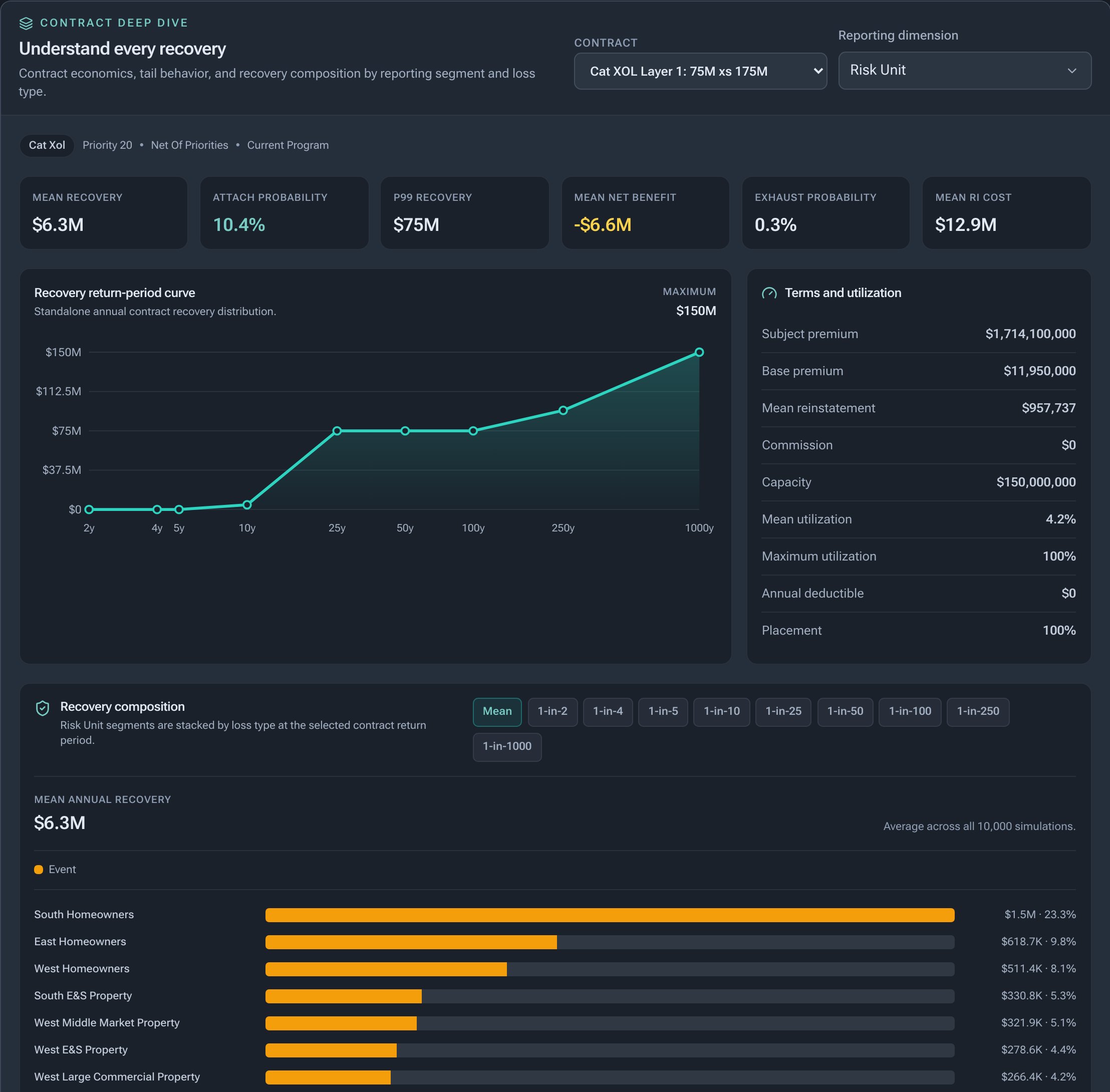
Screenshots from the demo model: a fictional carrier with 100 risk units and 10,000 simulations.
Insurers already invest considerable effort in pricing and reserving. Assumptions developed through work in tools such as ResQ and Akur8 Reserving provide part of the starting point for a capital model, alongside underwriting exposures, catastrophe assumptions, dependencies and reinsurance terms.
Platforms serving these teams are well placed to bring capital and reinsurance analysis to the same customers. Aktua provides an existing engine and modeling interface to build on.
Extend the questions customers can answer with their work: how the portfolio's risks combine, what drives capital requirements and how reinsurance changes the outcome.
Use detailed portfolio models to compare reinsurance programs and support capital decisions, with a common basis for exploring assumptions and discussing results.
A 30-minute walkthrough of a synthetic portfolio: the assumptions, the reinsurance structures and the results. Then a conversation about your customers and where Aktua could fit.
Arrange a walkthrough Technical documentation and benchmark results are available for further evaluation.